

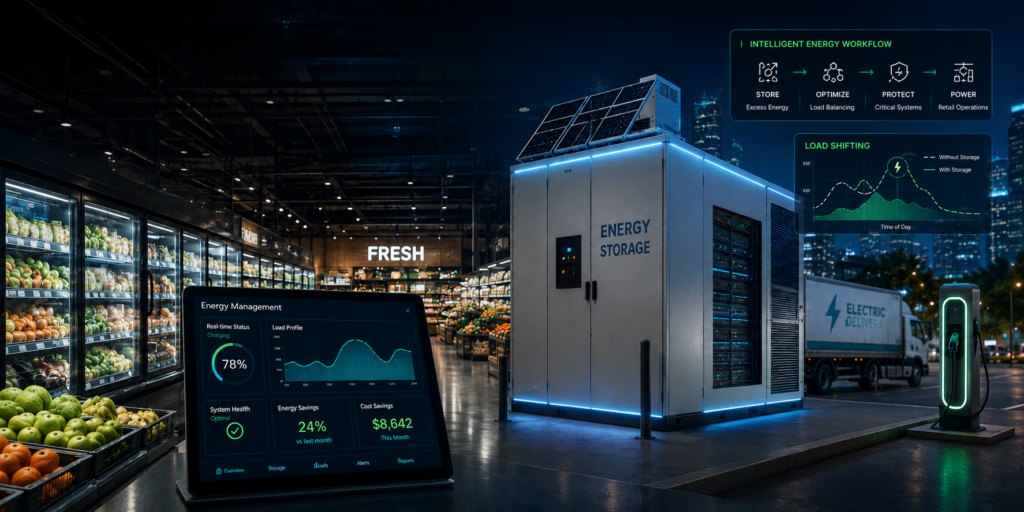
Energy Storage in Retail: What Supermarkets Should Evaluate Before Investing
Supermarkets operate in an environment where energy is essential to nearly every part of the business. Refrigeration, heating, ventilation and air conditioning (HVAC), lighting, food preparation, and other equipment must operate reliably throughout the day.
For supermarket operators, energy is not simply a utility expense. It is connected to operating costs, equipment performance, business continuity, and the ability to maintain appropriate conditions for products and customers.
Energy storage is one technology that may help address some of these challenges. However, installing a battery system is not automatically the right decision. Its suitability depends on the facility’s energy consumption, electricity tariff, operating requirements, existing infrastructure, and financial objectives.
The better starting point is to understand the energy challenge before selecting a technology.
Why Energy Management Matters in Supermarkets
Refrigeration is one of the major energy demands in supermarket operations. HVAC, lighting, and other electrical loads also contribute to the facility’s overall consumption.
These systems do not necessarily operate at the same level throughout the day. Demand can change with operating hours, outdoor temperatures, equipment cycles, deliveries, customer activity, and seasonal conditions.
Understanding when and how energy is consumed can help operators identify opportunities to improve efficiency and manage electricity costs.
The U.S. Department of Energy identifies supermarket refrigeration as a significant energy use and highlights opportunities involving refrigeration efficiency, controls, and system operation.
What Energy Storage Can Do
A battery energy storage system stores electricity for use at a later time. Depending on the system configuration, operating strategy, and applicable electricity tariff, it may support several business objectives.
- Managing Peak Electricity Demand
Some commercial electricity tariffs include demand charges based on the highest level of electricity demand during a billing period.
A properly designed battery system may discharge during selected high-demand periods to reduce the amount of electricity drawn from the grid at those times. This approach is commonly called peak shaving.
Whether this creates meaningful financial value depends on the facility’s demand profile, utility tariff, battery performance, and operating strategy.
- Shifting Energy Use
Energy storage may allow a facility to charge a battery when electricity is less expensive and use stored energy during periods when electricity prices or demand charges are higher.
The potential benefit depends on the difference between applicable electricity rates, battery efficiency, operating costs, and the timing of the facility’s energy requirements.
- Supporting Business Continuity
Depending on its design and configuration, an energy storage system may provide backup power to selected loads during an outage.
However, not every battery installation provides backup power. The system must be designed for that purpose, with appropriate electrical equipment, controls, capacity, and operating arrangements.
For supermarkets, it is important to identify which loads are critical, how long they need support, and whether refrigeration and other essential systems can operate safely under the proposed backup arrangement.
- Supporting Renewable Energy
Where a supermarket has on-site solar generation, battery storage may help store excess electricity for later use.
The business case depends on the site’s generation profile, energy consumption, electricity rates, system costs, and applicable utility arrangements.
Battery Storage Is Not Always the First Solution
Before considering a battery installation, organizations should examine the existing energy environment.
In some facilities, improvements to refrigeration equipment, HVAC controls, lighting, maintenance practices, scheduling, or energy monitoring may address important problems without requiring a battery system.
Other options may include demand-response programs, load shifting, thermal energy storage, or improvements to building and energy management systems.
The objective should not be to adopt the most advanced technology. It should be to identify the most suitable approach for the business need.
What Should a Supermarket Evaluate Before Investing?
A structured assessment should consider several areas.
Energy Consumption and Demand Patterns
Review electricity bills, interval meter data where available, peak demand periods, seasonal patterns, and major equipment loads.
The organization should understand not only how much electricity it consumes, but when demand occurs and which systems contribute to it.
Electricity Tariff and Financial Structure
Review the applicable electricity tariff, including energy charges, demand charges, time-of-use pricing, and other relevant costs.
A battery’s financial value cannot be determined from electricity consumption alone. The tariff and the facility’s actual load profile are essential to the analysis.
Critical Operations and Continuity Requirements
Identify which systems must remain operational during a power interruption.
Determine the required backup duration, critical load capacity, operating constraints, and any food safety or business continuity considerations.
Existing Infrastructure and Compatibility
Examine the existing electrical infrastructure, energy management systems, on-site generation, and equipment that may interact with the proposed storage solution.
Technical feasibility, available space, safety requirements, and utility interconnection considerations should be evaluated by qualified specialists.
Financial Feasibility
Compare the expected costs and potential value of the proposed solution.
Consider equipment, installation, maintenance, replacement, operating costs, incentives where applicable, and the assumptions used in any projected savings or return-on-investment calculation.
Financial projections should be based on actual site data and clearly stated assumptions rather than generic industry estimates.
Provider Capabilities and Responsibilities
Evaluate potential providers based on relevant experience, technical qualifications, system design, safety provisions, warranties, maintenance arrangements, monitoring capabilities, and ongoing support.
Clarify who is responsible for engineering, permitting, installation, commissioning, utility coordination, and long-term system operation.
How Innovomix Approaches the Opportunity
Innovomix approaches energy-related technology decisions from the business and operational requirements outward.
Rather than starting with a predetermined battery product or technology, we help organizations clarify what they are trying to achieve and evaluate whether energy storage or another approach may be appropriate.
This may involve:
- Understanding the organization’s energy and operational objectives.
- Identifying the information needed to assess consumption and demand patterns.
- Clarifying critical loads and business continuity requirements.
- Evaluating potential solution approaches and their trade-offs.
- Comparing suitable technologies and specialist providers.
- Helping clarify scope, responsibilities, costs, and implementation considerations.
- Coordinating stakeholders and delivery activities when engaged.
Where detailed energy engineering, electrical design, system installation, or commissioning is required, those activities should be performed by appropriately qualified specialist providers under clearly defined responsibilities.
The Business Decision Comes First
Energy storage can be a useful option for some supermarket operations, but its value is not universal.
The right decision depends on the facility, its energy profile, electricity tariff, operational requirements, infrastructure, and financial objectives.
A thoughtful evaluation may lead to a battery system, improvements to existing equipment, better energy controls, a demand-response strategy, or a combination of approaches.
The important step is to understand the business need, evaluate the available options, and select a solution based on evidence rather than assumptions.
The right technology decision starts with the right business question.
Sources and Further Reading
- S. Department of Energy – Refrigeration in Commercial Buildings
- S. Energy Information Administration – Energy Storage for Electricity Generation
- S. Department of Energy – Federal Demand Flexibility
This article provides general business and technology information. Site-specific energy, engineering, financial, safety, and regulatory assessments should be performed by appropriately qualified professionals.